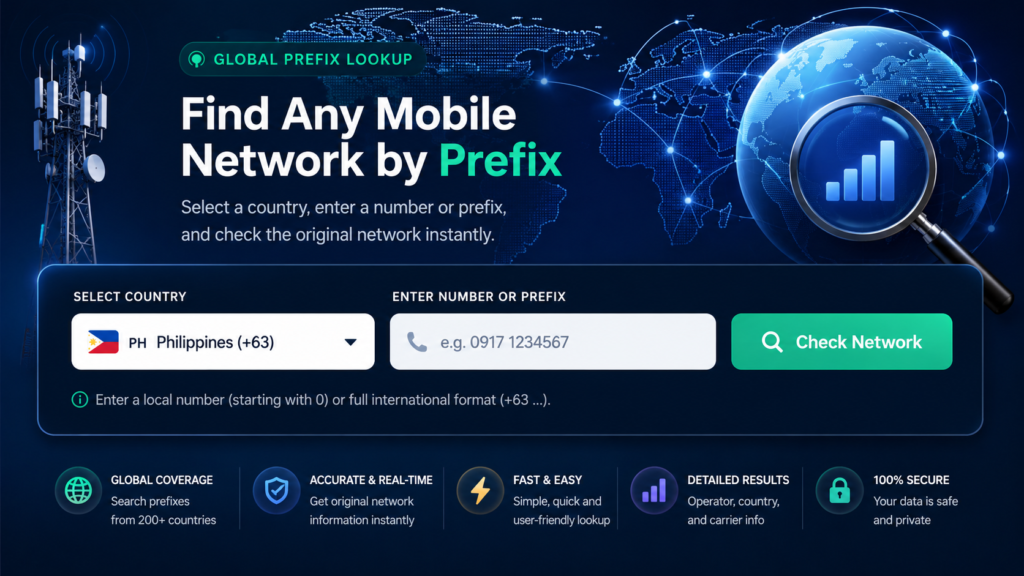
Find Any Mobile Network by Prefix
Select a country, enter a number or prefix, and check the original network instantly.
Every mobile number carries a hidden signature. Before you even dial, the first few digits of a phone number quietly tell a story — which telecom operator issued it, which country it belongs to, and sometimes even which region within that country. This signature is called a mobile prefix, and understanding it is one of the most practical bits of telecom knowledge you can have.
Use the Prefix Finder tool above to check any number instantly. Below, you’ll find a complete breakdown of how prefixes work in different countries, popular prefix lists by network, and answers to the questions people ask most.
What Is a Mobile Prefix?
A mobile prefix is a short block of digits — usually the first 3 to 4 numbers of a local mobile number — that a telecom regulator assigns to a specific operator. When a new mobile network launches or an existing one needs more numbers, the regulator allocates it a fresh block of prefixes. Every number issued from that block starts life belonging to that operator.
This matters for a simple reason: knowing a caller’s network can help you decide which promo to use, whether a call will be “on-net” (same network, usually cheaper) or “off-net,” and whether an unfamiliar number might be local or international.
One important caveat that applies almost everywhere: most countries have introduced Mobile Number Portability (MNP) — a system that lets subscribers switch operators while keeping their existing number. Once MNP exists, a prefix only tells you the original operator, not necessarily the current one. We flag this clearly for every country below, because treating a prefix as a 100% guarantee can lead to wrong assumptions.
Philippines 🇵🇭
The Philippines is one of the clearest examples of a prefix-based system still working well in daily life, even after MNP. Numbers are 11 digits long, written as 09XX-XXX-XXXX, and the first four digits (the prefix) identify the network.
| Network | Common Prefixes |
|---|---|
| Smart / TNT | 0907, 0908, 0909, 0910, 0912, 0918, 0919, 0920, 0921, 0928, 0929, 0930, 0938, 0939, 0946–0949, 0961, 0998 |
| Globe / TM / GOMO | 0817, 0905, 0906, 0915–0917, 0926, 0927, 0935, 0936, 0945, 0953–0959, 0965–0967, 0975–0979 |
| DITO | 0895–0898, 0991–0994 |
DITO Telecommunity, the newest of the three major networks, launched in 2021 with a distinct, easily identifiable block starting with 089 and 099 — making it the easiest network to spot at a glance. Smart and Globe, by contrast, have absorbed several older sub-brands (Sun Cellular into Smart; Cherry Prepaid and GOMO under Globe) over the years, so their prefix ranges are wider and occasionally overlap in public references. If you ever see a prefix not listed here, it’s likely a newer allocation — regulators add blocks periodically as demand grows.
India 🇮🇳
India’s system works differently from most countries, and it’s worth understanding why a simple prefix lookup doesn’t give a clean, single answer here.
Indian mobile numbers are 10 digits and start with 6, 7, 8, or 9:
- 6xxx — predominantly Reliance Jio, which operates as a 4G/5G-only network.
- 7xxx — a shared range used by Jio, Airtel, Vodafone Idea (Vi), and BSNL.
- 8xxx — mostly Airtel and Vi.
- 9xxx — shared across Airtel, Vi, BSNL, and MTNL (the latter serving Delhi and Mumbai specifically).
The reason for this overlap is India’s telecom circle system: the Department of Telecommunications divides the country into 22 licensed service areas, and each operator is allocated number blocks separately within each circle. The same starting digits can belong to different operators depending on the circle. Add nationwide MNP (active since 2011) on top of that, and a clean “digit-to-operator” mapping simply doesn’t exist at the four-digit level the way it does in the Philippines or Pakistan. For India, prefix lookups are best treated as a general range indicator rather than a precise carrier match.
Pakistan 🇵🇰
Pakistan uses a clean, well-documented 4-digit prefix system regulated by the Pakistan Telecommunication Authority (PTA), covering the 03XX numbering block.
| Network | Prefix Range |
|---|---|
| Jazz (Mobilink) | 0300–0309 |
| Jazz (legacy Warid) | 0320–0325 |
| Zong | 0310–0319 |
| Ufone | 0330–0339 |
| Telenor | 0340–0349 |
| SCOM | 0355 |
Jazz is the result of a 2016 merger between Mobilink and Warid, which is why it carries two separate prefix blocks today. Zong, backed by China Mobile, has become known for strong 4G coverage and holds the 031x block in full. SCOM (Special Communications Organization) is a smaller, regionally focused operator serving Azad Jammu & Kashmir and Gilgit-Baltistan, which is why its footprint is limited to a single prefix.
Bangladesh 🇧🇩
Bangladesh keeps things simple with a 3-digit operator code (after the leading 0), regulated by the BTRC (Bangladesh Telecommunication Regulatory Commission).
| Network | Prefixes |
|---|---|
| Grameenphone | 017, 013 |
| Banglalink | 019, 014 |
| Robi | 018 |
| Airtel (merged with Robi) | 016 |
| Teletalk (state-owned) | 015 |
Grameenphone, the market leader, was the first operator to exhaust its original 017 block and had to open a second one (013) to keep up with demand — a pattern that tends to repeat in fast-growing mobile markets everywhere. Airtel Bangladesh formally merged into Robi’s operations, but its original 016 prefix block is still in active use and easily recognized separately from Robi’s own 018 numbers.
Nigeria 🇳🇬
Nigeria’s mobile market runs on a 4-digit prefix system under the Nigerian Communications Commission (NCC), and MNP has been active since 2013.
| Network | Common Prefixes |
|---|---|
| MTN | 0703, 0706, 0803, 0806, 0810, 0813, 0814, 0816, 0903, 0906, 0913, 0916 |
| Airtel | 0701, 0708, 0802, 0808, 0812, 0901, 0902, 0904, 0907, 0912 |
| Glo | 0705, 0805, 0807, 0811, 0815, 0905, 0915 |
| 9mobile (rebranded T2 in 2025) | 0809, 0817, 0818, 0908, 0909 |
Nigeria’s telecom history shows up in its prefixes: several networks that once had their own blocks — Starcomms, Multi-Links, Visafone — no longer operate independently, and their old ranges have since been reabsorbed into MTN and other active carriers. 9mobile’s 2025 rebrand to T2 didn’t change its prefix ownership, just the brand name attached to it, which is a good reminder that prefixes track the license, not the marketing name of the moment.
Indonesia 🇮🇩
Indonesia’s Ministry of Communication and Informatics regulates a large and fairly granular set of 4-digit 08XX prefixes across six major operators.
| Network | Prefixes |
|---|---|
| Telkomsel | 0811, 0812, 0813, 0821, 0822, 0823, 0851, 0852, 0853 |
| Indosat Ooredoo | 0814, 0815, 0816, 0855, 0856, 0857, 0858 |
| XL Axiata | 0817, 0818, 0819, 0859, 0877, 0878 |
| AXIS (owned by XL) | 0831, 0832, 0833, 0838 |
| Tri (3) | 0895–0899 |
| Smartfren | 0881–0889 |
Telkomsel, Indonesia’s state-linked market leader, runs several sub-brands under one umbrella — simPATI, Kartu Halo, Kartu AS, and the app-only By.U — all sharing the same underlying prefix pool. Tri, operated by Hutchison, is the easiest network to identify at a glance since its entire range sits inside the distinctive 089x block.
Saudi Arabia 🇸🇦
Saudi mobile numbers are 9 digits starting with 5, regulated by the Communications, Space and Technology Commission (CST). The second digit identifies the operator.
| Network | Prefixes |
|---|---|
| STC | 050, 053, 055 |
| Mobily | 054, 056 |
| Zain | 058, 059 |
Saudi Arabia introduced MNP back in 2006 — one of the earlier adopters in the region — using a centralized “All Call Query” system. A smaller set of prefixes (057, for instance) is reserved for MVNOs like Virgin Mobile and Lebara, which lease network capacity from the main three operators rather than running their own infrastructure.
United Arab Emirates 🇦🇪
The UAE keeps its mobile numbering simple, with just two licensed operators splitting the 05X block.
| Network | Prefixes |
|---|---|
| Etisalat | 050, 054, 056 |
| du | 052, 055 |
Etisalat, the UAE’s original state telecom operator, was allocated the first blocks when mobile service launched, and 054 was released more recently as demand grew. du entered the market in 2007 as the UAE’s first competing operator and was assigned 052 and 055.
USA 🇺🇸 and UK 🇬🇧
These two are worth calling out specifically, because they work differently from every country above — and it’s important to be upfront about that rather than presenting inaccurate matches.
In the United States, area codes are geographic, not carrier-based — a “212” number tells you it was originally issued in New York City, not that it belongs to Verizon or AT&T. Combined with full number portability (in place since 2003), there is no reliable way to identify a US carrier from the number alone.
The UK works similarly for mobiles: numbers starting with 07 are simply “mobile,” and full MNP (active since 1999) means the actual carrier behind any given 07 number could be any of the major networks (EE, O2, Vodafone, Three) regardless of which one it was originally issued to.
For both countries, this tool shows the correct country dialing code and format instead of a false carrier match — an honest “we can’t tell you that” is more useful than a guess that’s likely wrong.
Why Prefixes Still Matter, Even With Portability
It’s a fair question: if Mobile Number Portability means the prefix might not reflect the current network, why bother checking it at all? A few practical reasons:
- Most numbers are never ported. In every country studied here, the overwhelming majority of subscribers keep their original operator, so the prefix is still correct most of the time.
- It’s still the best available signal without a live carrier lookup. Real-time HLR (Home Location Register) lookups exist but usually cost money and require the operator’s cooperation; a prefix check is free and instant.
- It’s useful context, not a final verdict. For choosing a promo, guessing a caller’s origin, or filtering spam patterns, “originally issued to Network X” is genuinely useful information — just not a guarantee.
How to Use a Number’s Prefix Responsibly
- Treat results as the original operator, not necessarily the current one.
- For anything that matters legally or financially (verifying a business contact, confirming an official SMS sender, etc.), confirm through the operator’s official channels rather than relying on prefix data alone.
- If a prefix doesn’t match any listed block, it’s often because a newer range was recently allocated — regulators add blocks as demand grows, and directories like this one are updated periodically, not in real time.
- Remember that landline numbers follow a completely different, usually geographic, numbering system — prefix lookups here are built specifically for mobile numbers.
Frequently Asked Questions
No. Because of Mobile Number Portability, a prefix reliably shows only the original operator. The current operator can differ if the subscriber has ported their number.
Both countries assign numbers by geography (or simply as “mobile,” in the UK’s case) rather than by carrier, and both have had full portability for over two decades. Any carrier claim for these countries would be a guess, not a fact — so we don’t make one.
India allocates numbers by telecom circle (22 regional licensing zones), so the same starting digits can belong to different operators depending on the region. A precise match would require circle-level data, which this quick lookup doesn’t attempt.
Regulators periodically release new prefix blocks as operators grow. We review and refresh this list regularly, but if you spot a prefix that isn’t listed, it’s most likely a recent allocation we haven’t added yet.
Yes — reach out through our Contact page with the country you’d like covered, and we’ll prioritize adding it once we’ve verified accurate data.